A Comprehensive Perspective of Research Publications
The number of scholarly journals and articles has dramatically increased during the past decades. This, apparently out of control, expansion has been widely criticised in academia by stressing that no one really knows how many scholarly journals exist. The days of physical libraries are now over, as we are dependent on search engines to light our way.
The problem is that they usually are business ventures and do not show us the whole picture. For example, Google Scholar has been developed with the same logic as the Google search engine, and we really do not know about the coverage. Rather than indexing scholarly journals, it seems Google Scholar index any part of the web which looks like scholarly articles. Scopus, owned by the publishing giant Elsevier, indexes a fraction of the scholarly publications. Although it has always been stressed that it is a separate company, a quick search can reveal the dominance of Elsevier journals in the search results. On the other hand, Scopus needs an account even for its basic services.
Exaly, which has been developed as a non-profit project by a group of individual researchers, might be the game-changer. Exaly can be divided into two services: a full-text search engine and detailed statistical analysis of the publications at the journal, author, and institution levels. There are unique features of Exaly worthy of highlighting because of their absence in similar services.
The indexing boundaries of Exaly is transparent by covering all scholarly journals and nothing else (such as patents or unpublished documents as Google Scholar does). Books and book chapters are also covered by they can be excluded via simple search options. Quite interestingly, Exaly provides the possibility of searching in specific parts of the articles such as inside tables, figure captions, etc.
The most crucial aspect of Exaly is that it provides us with a map of scientific publications with various data and graphs.
Journals: Not only are the representative metrics of each journal, such as the impact factor and h-index, provided alongside the search results but also detailed scientometric analysis of each journal is also provided separately. The impact factor, which was previously considered a commercial product, is provided for all scholarly journals and throughout their history back to 1665.
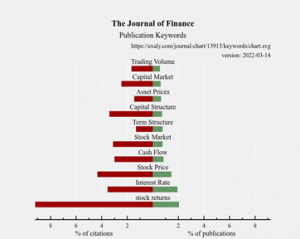
It is also possible to find the active areas of a journal. The scope of each journal covers a broad range of topics, but some areas gain traction. For example, these are the most popular topics covered by The Journal of Finance.
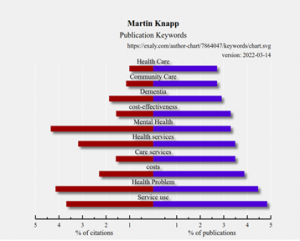
Authors: Google Scholar became popular by the author profiles providing a statistical analysis of each author’s publications. Exaly offers a wide range of citation analyses, such as who has cited the author in question and from which journals these citations come. Furthermore, a visual map of the research areas of each author reveal what topics the author has published more and, most importantly, the author’s citations come from which research topics. This is particularly of interest to the authors themselves. For instance, an author can quickly compare their performance in publications with different co-authors. The complete list of publications of each author in the CV style is downloadable with updated scientometric data such as the number of citations and the journal impact factors.
Similar to the journals, it is also possible to map an author’s most active research areas. Here is an example for Martin Knapp. In addition to the publications, it shows which topics were most embraced by the peers.
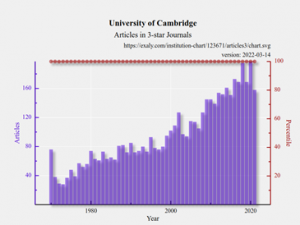
Institutions: University ranking is indeed a serious business as the fame and reputation of universities depend on it, and many attempts to provide creative and reliable metrics for this purpose. The research output is one of the critical factors in the university ranking, but there was no resource to provide the raw data. Exaly delivers a complete set of data for the publications and citations of each university. In addition, the publications have been divided into low-impact, high-impact, and exceptional journals. In the latter case, for example, the number of publications of each university in journals such as Science and Nature is counted. Here is an example of the publications of the University of Cambridge in prestigious journals.
The good news is that all the data and visualised graphs are licenced under Creative Commons and can be re-used without hassle.
How to Find the Right Journal for Your Research Article
Finding the right journal is the most tricky step in publishing a research article. This defines if we are reaching the enthusiastic audience or the research endeavour will be buried in the pile of unread scholarly articles. Scientometric studies reveal that most research articles are never cited. A potential reason is the wrong choice of the medium.
Most people choose the journal by matching the fields of their research and that of the targeted journal. This could be pragmatic decades ago, as each journal was indeed a niche for people working in the same field.
The structure of scientific publications is somehow changing. On the one hand, the interdisciplinary nature of recent research outlooks had made more journals suitable fits for a specific research article. On the other hand, journals do not evenly cover the entire field of their scope, though it is ideally intended. Therefore, matching the journal scope is not enough to reach the eager audience.
Instead, it is vital to find out if a journal is the hotspot of a specific topic. This is possible by searching the literature with the main keywords of the article. Some scholarly search engines provide an aggregated service to find the journals that have published more for that specific topic. The problem is that Elsevier-owned Scopus cover only a fraction of scholarly journal, and there is no wonder that most journals found by this method belong to Elsevier.
Exaly (exaly.com) is a better choice for two reasons. First, it is an independent non-profit project with no commercial interest in specific journals or preference in indexing. Thus, all scholarly are fully covered. Second, Exaly provides other services for examing the journals, as will be discussed later.
Exaly has a tailored service for finding relevant and high-performing journals for each keyword. The service can be found at https://exaly.com/journal-finder.php.
When searching for a keyword (don’t forget to use the double quote when searching for a phrase), the result is the list of journals that have published the most articles about that keyword. However, the resulting table has much more invaluable information to judge the best medium for publishing a paper. The next column shows the percentage of articles covering that keyword. In other words, it shows the journal’s weight on this specific keyword. Most interestingly, the number of citations of these articles are also provided. By dividing the number of citations by the number of articles about a keyword, you can find how much the journal successfully feeds the articles about this particular keyword to the targeted audience.
This matter is of utmost importance, though it is usually neglected. People tend to publish in journals with higher impact factors without considering how well their articles perform. It is not beneficial to publish in a high impact factor but receives little or no attention from the audience. It is a known fact that a fraction of articles published in a journal usually contributed to the journal impact factor. Therefore, it is a more substantial achievement to publish in a journal with a lower impact factor but more citations.
It is indeed the primary marketing strategy: the size of the audience does not matter if they are not the target. It does not make sense to report a piece of local news in the national media of another country.