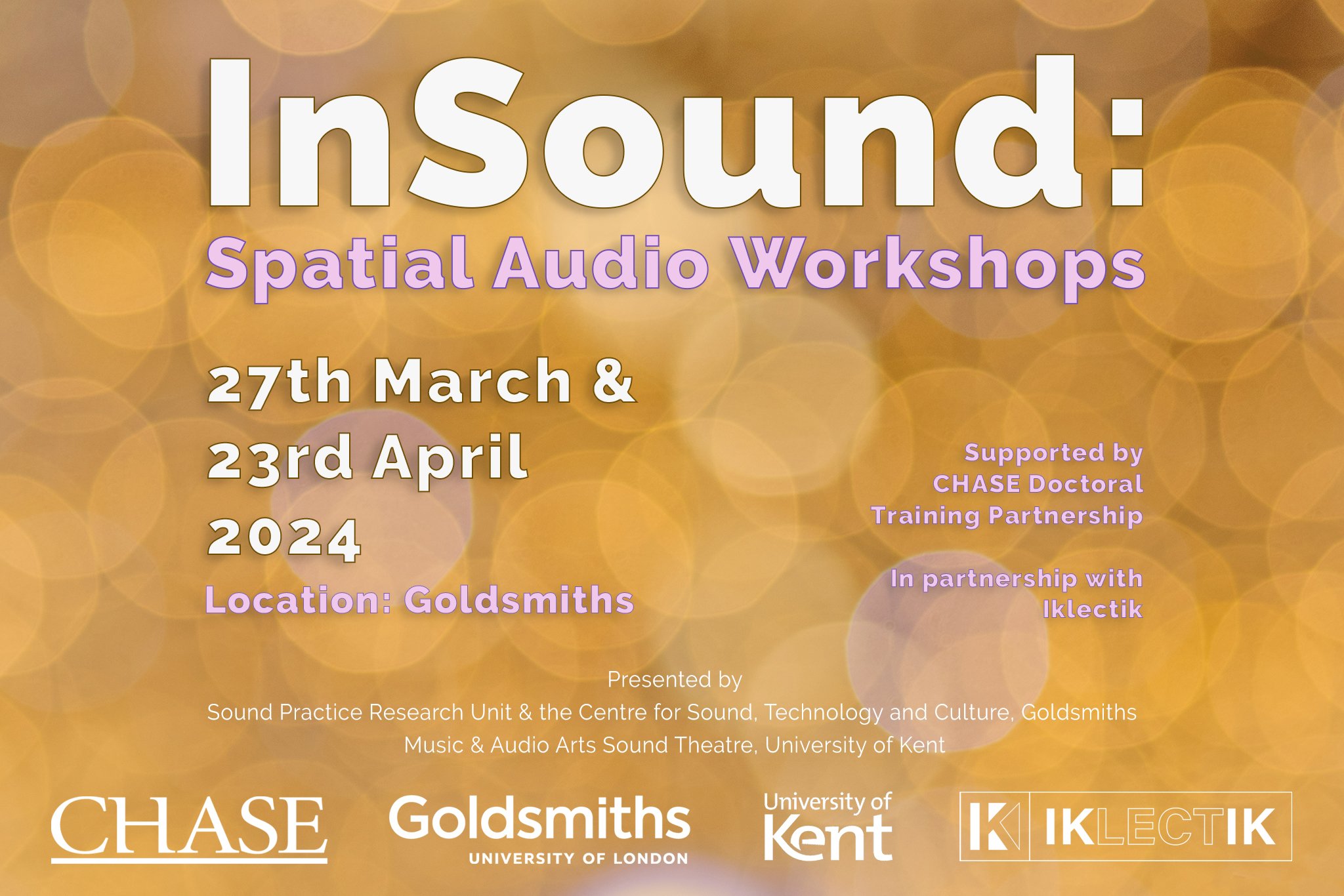
Dates: Wednesday 27th March 2024 and Tuesday 23rd April 2024
Location: Goldsmiths, University of London, New Cross, London SE14 6NW
Goldsmiths and University of Kent, in partnership with Iklectik, offer two days of spatial audio workshops for composers, music producers and sound artists interested in deepening their understanding of immersive audio and applying spatialisation techniques to their compositional material.
These workshops focus on spatial audio as a compositional practice, developing practitioners’ skills and knowledge to work with various spatial audio configurations and approaches, such as multichannel, ambisonics, and Dolby Atmos. The sessions are scheduled with time between to allow participants to apply the knowledge gained from session one to their own practice and produce material suitable for spatialisation in session two.
Session One: Spatial Audio Approaches and Technologies
Wednesday 27th March 2024
The morning session will comprise of seminars in the Sonic Immersive Media Lab from artists and staff at Goldsmiths, University of Kent and Iklectik. There will be a lunchtime listening session. The afternoon will feature workshops on spatial audio technologies in the Electronic Music Studios. Participants will be given guidance and suggested tools to help them develop their material for the next session. The final session of the day will invite participants to discuss strategies for working with spatial audio in their own practice.
Participants are asked to bring some audio files of their own material on a USB/memory key. These will be used in the seminars to demonstrate and explore different techniques.
Session Two: Spatialising Your Material
Tuesday 23rd April 2024
This session provides participants with the opportunity to spatialise their own material working in the Goldsmiths Electronic Music Studios, Synth Lab and with Iklectik. Participants will be allocated an individual slot to work 1-to-1 with a workshop leader on the spatialisation of their material.
Please note, this session is only suitable for practise-based researchers. Please indicate on the registration form that you are interested in taking part in this session.
FAQs
Q Can I attend just one session?
A It is possible to attend just session one, but session two is not standalone and you must attend session one as well.
————
Q My research is not practise-based, can I still attend?
A Session one prioritises practise-based attendees but it is not essential. However, session two is only useful for non-practice-based researchers.
Participants and Registration
No prior experience with working with spatial audio systems is required.
A detailed schedule will be shared with registered participants.
This training is primarily aimed at practice-based researchers, however non-practice-based researchers are invited to attend the morning session of session one. Please state if you wish to only attend the morning of session one.