Have you got an idea for an online community, but you are not sure where to start?
We would like to help you bring that idea, and community, to life!
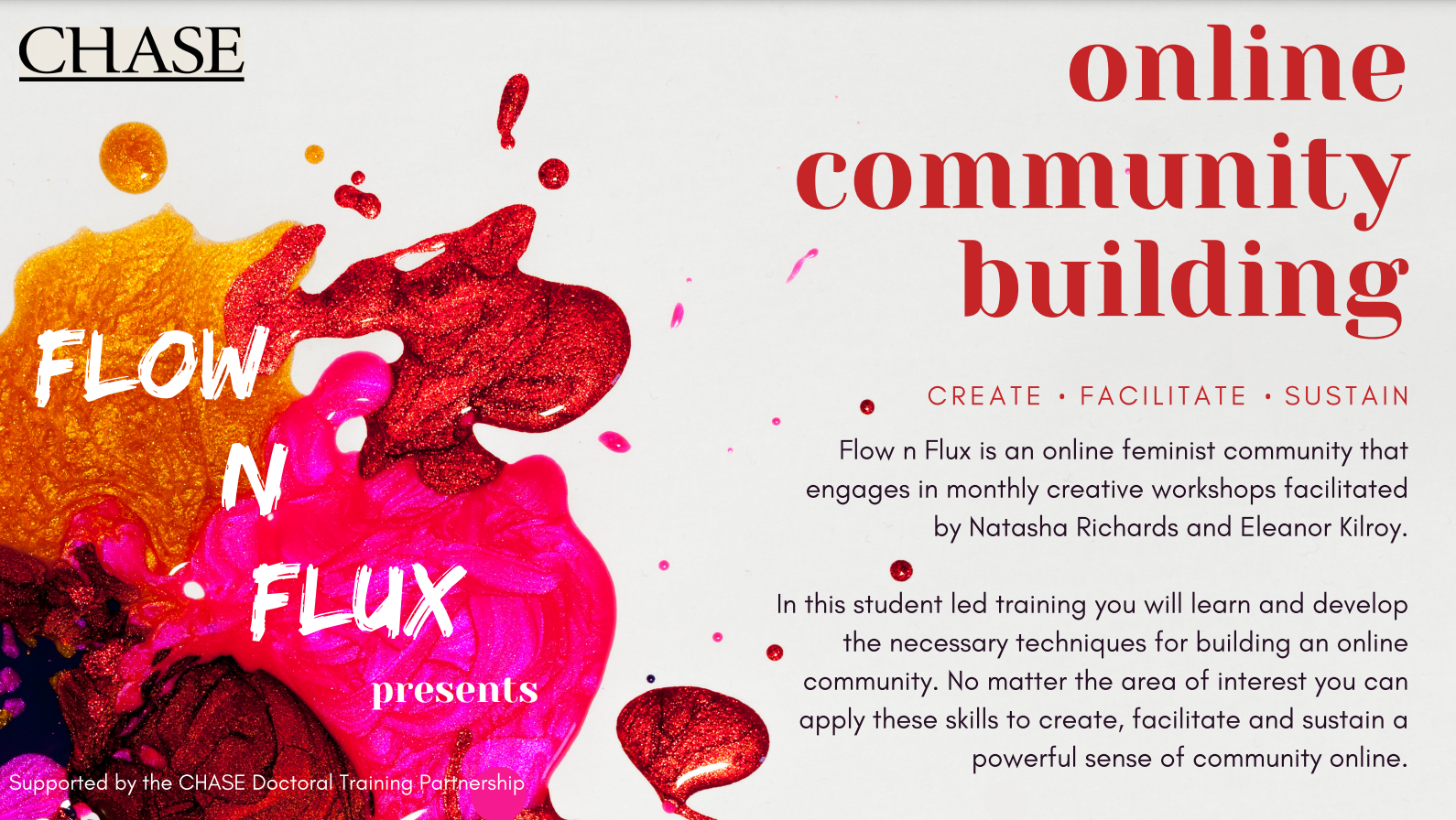
Flow n Flux presents: Online Community Building – Create, Facilitate, Sustain
Flow n Flux is an online feminist community that engages in monthly participatory workshops facilitated by Natasha Richards and Eleanor Kilroy.
In this student led training you will learn valuable techniques necessary for building an online community. No matter the area of interest you can apply these skills to create, facilitate and sustain a sense of community online.
Here is a little taster of what to expect on the day.
10.00-11.00: Introduction
To begin with we will welcome you all to the training and share the origins of Flow n Flux. We will also start to discuss your ideas for an online community. Do not worry if you do not have an idea before the workshop, as the session may spark some ideas.
11.00-12.00: How to build
Next we will discuss marketing and advertising, as well as the organisational development tasks necessary for getting your online community off the ground.
12.00-13.00: How to facilitate
Then we will explore the skills and knowledge necessary for planning and running the online community. We will also discuss how to respond to potential challenges
13.00-13.30: Lunch
13.30-14.30: How to sustain
After lunch we will focus on how to increase and sustain your membership. We will develop strategies for addressing common pitfalls in sustaining an online community.
14.30-16.00: Your online community
In the final section of the day participants will have the chance to share their ideas for an online community and to receive feedback from other participants.
Thursday 2 December UK time, 1900-2100 | Online
Join Jasleen Kaur and Raju Rage for a sharing and discussion on their conversation ‘Teflon and Resistance: disordered eating, indigestible truth and healing’, where they discuss their projects and publications Be Like Teflon (2019) and Recipes for Resistance (2020) and their wider contexts and concerns, that relate to the marginalisation of genders and sexualities, through the lens of South Asian identity.
A session to further strategize on how we actively (continue to) create inclusive feminist spaces, alliances and solidarities amongst marginalised people that allow for a breadth and depth of conversation around varying identities and shared oppressions that manifest differently, especially in light of divisions amongst feminisms.
Expression of Interest
Spaces for this online workshop will be limited to maintain a mood of intimacy and exchange. If you would like to take part, please send a short Expression of Interest by Monday 15th November to feministduration@gmail.com. We will let you know by Monday 22nd November if you have been selected, and will then provide further details of the session.
Jasleen Kaur
Born in Glasgow, Scotland, Jasleen is an artist based in London. Her work is an ongoing exploration into the malleability of culture and the layering of social histories within the material and immaterial things that surround us. Her practice examines diasporic identity and hierarchies of history, both colonial and personal. She works with sculpture, video and writing. Recent and upcoming commissions include Wellcome Collection, UP Projects, Glasgow Women’s Library, Market Gallery, BALTIC Centre for Contemporary Art, Eastside Projects and Hollybush Gardens. Her work is part of the permanent collection of Touchstones Rochdale, Royal College of Art and Crafts Council.
Raju Rage
Born in Kenya, raised in London and living/working beyond, Raju explores the spaces and relationships between dis/connected bodies, theory and practice, text and the body and aesthetics and the political substance. Their current interests are around sustainability, economies, care, and resistance. They are a member of Collective Creativity arts collective and are a creative educator and independent scholar with an interest in radical pedagogy. Raju has a theirstory in activism, self and collective organised queer/ transgender/ people of colour movements and creative projects in London and beyond from which their politics and works draw on and from. They have trained as a pastry chef and baker, worked in several community kitchens and been part of a baker’s collective.
Feminist Duration
This workshop is part of the Feminist Duration series which explores under-known texts, ideas, and movements associated with earlier periods of feminist activity in the UK. Originally designed as part of a year-long residency at the South London Gallery, and rescheduled online in the wake of the COVID pandemic, the programme juxtaposes earlier moments of feminist with current urgencies and struggles.
By restoring material texture to overlooked political and cultural movements, it seeks to resist versions of the past that reduce feminist struggle to one-dimensional stereotypes. Looking to the past to activate its nascent potential, the programme aims to identify tools that can inspire and enrich further collective action, promoting the intergenerational exchange of knowledge and experience. While honouring earlier feminisms, the series also highlights how collaboration, difference, and dissent have characterised previous feminist movements, and how feminists have both negotiated, and failed to significantly attend to, differences between themselves.
feministduration.com
9 December UK Time, 1900-2100 | Online
Artist filmmaker Rhea Storr leads an online session exploring themes of her 2020 essay ‘The Black Aesthetic as an Agent of Community: Radical Organising in the UK and USA,’ Non Fiction Journal, 2020. During the session we will read out loud together from Rhea’s essay, and view and discuss her film, ‘A Protest, ‘A Celebration, A Mixed Message,’ 2018 (2018).
Reading and screenings will open up discussions on questions including:
- Do any of these ideas around the Black Aesthetic translate to other groups which might be misrepresented or less visible? (Can for instance themes of community, circulation and archive speak to feminism in the same way as Black Aesthetics)?
- What effects do the objects (the accumulation of records or media or costume for instance) have on the films overall?
- Who is on the inside and who is on the outside of the communities being created? Who is the film made for and what is hidden from us?
- How might aesthetics predicated on a specific group of people circulate?
EventBrite Registration
Registration will close one hour before the event (18.00 hrs December 9th, 2021)
Rhea Storr
Rhea Storr is an artist filmmaker who explores the representation of Black and mixed-race cultures. Masquerade as a site of protest or subversion is an ongoing theme in her work. So, too, is the effect of place or space on cultural representation. Rhea Storr often works in 16mm film; she considers that analogue film might be useful to Black artists, both in the aesthetics it creates and the production models it facilitates. She is currently undertaking a PhD entitled ‘Towards a Black British Aesthetic: How is Black Radical Imagination realised through 16mm filmmaking practices?’ She is a co-director of not nowhere an artists’ film co-operative, London, that has a particular focus on analogue film. She is resident at Somerset House, London and programmes at Alchemy Film and Moving Image Festival. She is the winner of the Aesthetica Art Prize 2020 and the inaugural Louis Le Prince Experimental Film Prize. She was educated at Oxford University and the Royal College of Art.
Further Readings
Robin Kelley, Freedom Dreams: The Black Radical Imagination, Beacon Press: Boston, 2003
E. Jane, Nope (a manifesto), http://www.e-jane.net/
Legacy Russel, Glitch Feminism: A Manifesto, Verso: Brooklyn, 2020
Martine Syms, The Mundane Afrofuturist Manifesto, rhizome.org, 2013 http://thirdrailquarterly.org/martine-syms-the-mundane-afrofuturist-manifesto/
Feminist Duration
This workshop is part of the Feminist Duration series which explores under-known texts, ideas, and movements associated with earlier periods of feminist activity in the UK. Originally designed as part of a year-long residency at the South London Gallery, and rescheduled online in the wake of the COVID pandemic, the programme juxtaposes earlier moments of feminist with current urgencies and struggles.
By restoring material texture to overlooked political and cultural movements, it seeks to resist versions of the past that reduce feminist struggle to one-dimensional stereotypes. Looking to the past to activate its nascent potential, the programme aims to identify tools that can inspire and enrich further collective action, promoting the intergenerational exchange of knowledge and experience. While honouring earlier feminisms, the series also highlights how collaboration, difference, and dissent have characterised previous feminist movements, and how feminists have both negotiated, and failed to significantly attend to, differences between themselves.
Tuesday 24th May | 10:30 – 13:30 | Sussex Humanities Lab
Dr. Sharon Webb, Senior Lecturer in Digital Humanities
This session will introduce participants to queer, feminist digital archives and will explore the ways digital humanities can support community groups and initiatives build digital archives. It will consider the creation of community archives within identity groups as a way to reclaim or promote hidden, lost and/or oppressed histories. It will then consider some tools to support the creation of digital archives, particularly, Omeka, and will provide an introduction to metadata and the concept of feminist ethics of care in archiving.
Participants are asked to bring a digital image of an object/document/photograph/etc., that they would add to an archive, and think of the reasons why. (Please do not bring the object, just a digital image of it). Participants will also have access to primary source material stored in the Lab which we can also work with as an alternative.
During the session we will write metadata and if appropriate upload to a live archive. We will be contributing to one, or both, of the following archives
-
https://archives.reanimatingdata.co.uk
-
https://www.queerheritagesouth.co.uk/s/queer-heritage-south/page/home
Reference material
-
Eichhorn, K. The Archival Turn in Feminism: Outrage in Order (2013)
-
Kumbier, A. Ephemeral Material – Queering the Archive (2014)
-
Cvetkovich, A., An Archive of Feelings: Trauma, Sexuality, and Lesbian Public Cultures (2003)
-
Marika, C & Wood, S. Critical Feminism in the Archives in Journal of Critical Library and Information Studies (2017)
-
Ashton, J., Feminist Archiving [a manifesto continued ]: Skilling for Activism and Organising in Australian Feminist Studies (2017)
-
Dever, M., Archives and new modes of feminist research (2019)
-
Cowan, T.L., & Rault, J., Onlining queer acts: Digital research ethics and caring for risky archives in Women & Performance: a journal of feminist theory (2018)
Participants are asked to take a lateral flow test prior to attending and are asked to wear a mask during the duration of the session.
In a session combining film screening, out loud reading, and discussion, curator and researcher Nora Heidorn and artist Onyeka Igwe think together about questions of how to work (with each other, with other’s stories, with images, documents, complex histories, etc.). The reading group meeting will take place in person and is kindly hosted by Mimosa House.
Reading & Viewing
We will read out loud together from Igwe’s article ‘being close to, with or amongst’ (‘Feminist Review,’ 2020) and watch her film Specialised Technique (2018).
The article elaborates Igwe’s working method of “critical proximity”: a way of interrogating, getting close to, and manipulating colonial films shot in West Africa that she encountered in British archives. The article and film will serve as a starting point to explore together questions of how to work: the process of developing creative, critical methodologies and feminist approaches to one’s projects, practices and concerns.
There is no need to read the article beforehand, as we will read out loud together, one person, one paragraph at a time.
Bios
Nora Heidorn curates exhibitions, public programmes, artist projects, and publishes her writing. Her practice is led by interdisciplinary research investigating sexual reproduction, health, and care through an intersectional lens and using artistic methods. She is undertaking an LAHP-funded PhD at the Royal College of Art, London in collaboration with Birth Rites Collection and she teaches at Central Saint Martins College, London. This year, she curated the exhibition Onyeka Igwe: Dancing with the Archive at Uferstudios in Berlin and the screening Being Horizontal: Vulnerability, Care and Resistance as part of Confabulations: Art History, Art Practice, Critical Medical Humanities and she presented her PhD research in a paper titled Touching Matters of Care: A Visual Approach to the Care and Violence in Dr Marie Stopes’ Birth Control Campaign at the Institute of Cultural Inquiry in Berlin.
Onyeka Igwe is an artist and researcher working between cinema and installation. She is born and is based in London, UK. Working across cinema and installation, Igwe creates non-fiction films that use text, images, and film from historical archives to shift the maps of how we understand the past and the present. Her films unfold like figure eights, led through music, performance, and mesmerizing voice-overs. Using a forensic lens, she draws audiences into individual and shared stories that expand onto a multiplicity of narratives, rather than a singular, reductive history. Igwe was awarded the 2021 Foundwork Artist Prize, 2020 Arts Foundation Futures Award for Experimental Short Film, and is the recipient of the Berwick New Cinema Award in 2019.
Nora and Onyeka recently worked together on Onyeka’s first solo exhibition in Germany, Dancing with the Archive at Uferstudios in Berlin (2022).
Image Credit
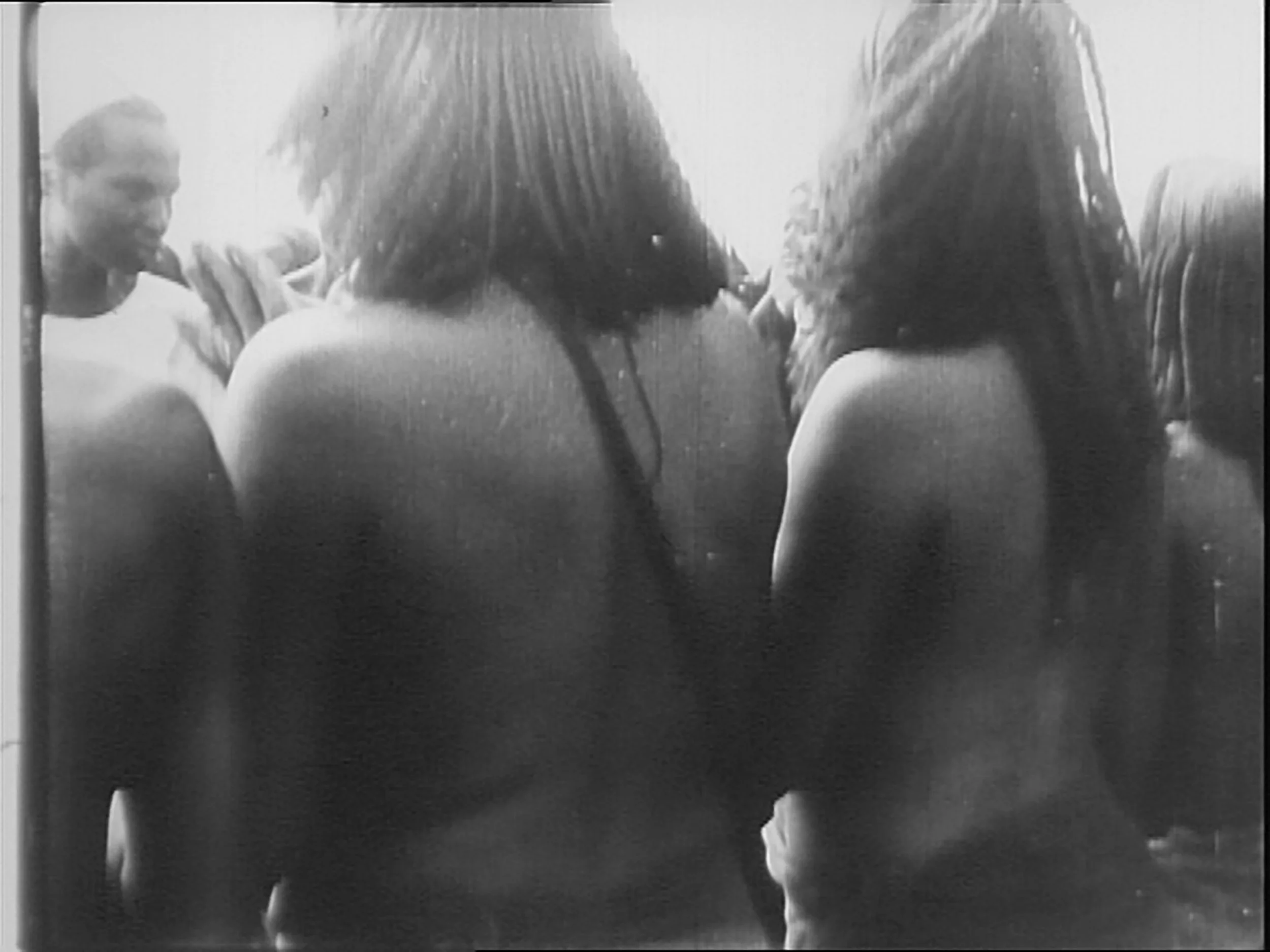
Still from Onyeka Igwe, Specialised Technique (2018)
Feminist Duration
This workshop is part of the Feminist Duration series which explores under-known texts, ideas, and movements associated with earlier periods of feminist activity in the UK. Originally designed as part of a year-long residency at the South London Gallery, and rescheduled online in the wake of the COVID pandemic, the programme juxtaposes earlier moments of feminist with current urgencies and struggles. By restoring material texture to overlooked political and cultural movements, it seeks to resist versions of the past that reduce feminist struggle to one-dimensional stereotypes. Looking to the past to activate its nascent potential, the programme aims to identify tools that can inspire and enrich further collective action, promoting the intergenerational exchange of knowledge and experience. While honouring earlier feminisms, the series also highlights how collaboration, difference, and dissent have characterised previous feminist movements, and how feminists have both negotiated, and failed to significantly attend to, differences between themselves.